Existe um momento silencioso que muitas famílias conhecem bem: o jantar em que cada um olha para a própria tela, a viagem de carro em que o fone de ouvido substitui a conversa, o final de semana que passa sem que pai e filho troquem mais do que instruções práticas. Não é falta de amor. É falta de ponte.
O Método GpA — Grandes e Pequenos Autores nasceu exatamente nessa lacuna. É uma metodologia criada para transformar a escrita colaborativa em instrumento de conexão genuína entre pais e filhos, avós e netos, famílias inteiras que têm histórias para contar mas perderam o hábito de contá-las juntas.
O Que é o Método GpA?
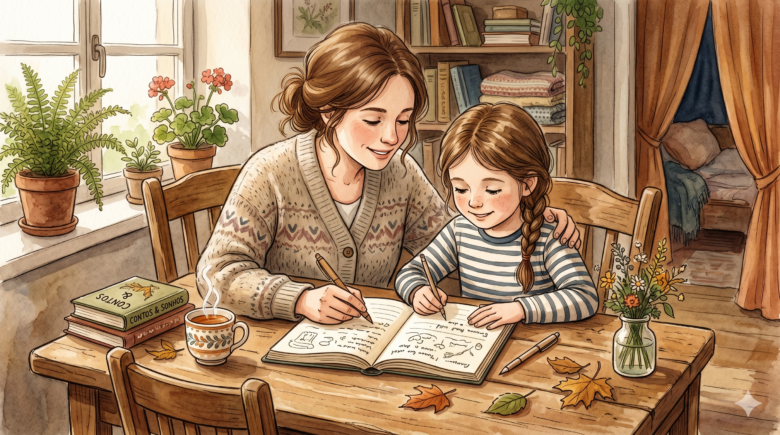
GpA é a sigla para Grandes e Pequenos Autores — uma proposta que coloca, lado a lado, gerações diferentes diante de uma folha em branco. Não como uma tarefa escolar. Não como uma obrigação. Mas como um ato de presença.
A ideia central é simples e poderosa: quando uma criança e um adulto escrevem uma história juntos, eles não estão apenas criando um texto. Estão negociando perspectivas, revelando valores, compartilhando medos e sonhos. Estão, em essência, se conhecendo de uma forma que o cotidiano raramente permite.
Por Que a Escrita?
Poderia ser qualquer outra atividade — e muitas famílias tentam jogos, esportes, viagens. Mas a escrita tem algo que poucos recursos têm: ela exige que as pessoas se ouçam.
Para escrever juntos, é preciso perguntar. É preciso ouvir a resposta. É preciso ceder, combinar, imaginar em parceria. Esse processo, aparentemente simples, ativa algo profundo: a criança sente que sua voz importa. O adulto redescobre a capacidade de maravilhar-se. E entre os dois, surge um texto que pertence a ambos — um legado concreto, palpável, que pode ser guardado, lido anos depois, passado adiante.
O Que a Ciência Diz
Pesquisas em neurociência e psicologia do desenvolvimento confirmam o que o coração já sabia: narrativas compartilhadas fortalecem vínculos. Crianças que crescem em famílias com cultura de contar histórias desenvolvem maior resiliência emocional, melhor desempenho escolar e um senso de identidade mais robusto.
A escrita colaborativa vai além: ela documenta a memória afetiva da família em tempo real. Cada história criada juntos se torna uma âncora emocional — um “nós fizemos isso” que resiste ao tempo e às telas.
Para Quem é o Método GpA?
Para a família que sente que o tempo está passando rápido demais e as conversas ficando rasas demais.
Para o pai que quer estar presente mas não sabe como entrar no mundo do filho.
Para a mãe que quer transmitir valores sem sermão.
Para os avós que têm histórias riquíssimas e netos que nunca as ouviram.
Para a família cristã que quer construir legado com propósito e fé.
Para qualquer família que acredita que amor também se pratica — e que pode ser escrito.
Como Começar
Você não precisa ser escritor. Não precisa de equipamento especial, tempo ilimitado ou talento literário. O GpA foi desenhado para a vida real — corrida, imperfeita e cheia de interrupções.
Comece com uma pergunta simples na hora do jantar: “Se nossa família fosse um personagem, qual seria seu superpoder?” Deixe a resposta virar conversa. Deixe a conversa virar história. Deixe a história ser escrita — no caderno, no celular, no guardanapo que estava na mesa.
O primeiro passo não precisa ser grande. Precisa ser dado.
Cris Breves é autora, revisora e criadora do Método GpA. Acredita que toda família tem um livro dentro de si — e que escrever juntos é uma das formas mais bonitas de lê-lo.
The Pen That Connects Generations: How the GpA Method Transforms Writing into Emotional Bonding
by Cris Breves | verbalizing8.com
There is a silent moment that many families know well: the dinner where everyone stares at their own screen, the car ride where headphones replace conversation, the weekend that passes without a parent and child exchanging more than practical instructions. It’s not a lack of love. It’s a lack of a bridge.
The GpA Method — Grandes e Pequenos Autores (Big and Small Authors) was born precisely in that gap. It is a methodology created to transform collaborative writing into a genuine tool for connection between parents and children, grandparents and grandchildren, entire families who have stories to tell but have lost the habit of telling them together.
What Is the GpA Method?
GpA stands for Big and Small Authors — a practice that places different generations side by side in front of a blank page. Not as a school assignment. Not as an obligation. But as an act of presence.
The core idea is simple and powerful: when a child and an adult write a story together, they are not just creating a text. They are negotiating perspectives, revealing values, sharing fears and dreams. They are, in essence, getting to know each other in a way that daily life rarely allows.
Why Writing?
It could be any other activity — and many families try games, sports, travel. But writing has something that few resources have: it requires people to truly listen to each other.
To write together, you need to ask questions. You need to listen to the answers. You need to yield, agree, and imagine in partnership. This seemingly simple process activates something profound: the child feels that their voice matters. The adult rediscovers the capacity for wonder. And between the two, a text emerges that belongs to both — a concrete, tangible legacy that can be kept, read years later, and passed down.
What Science Says
Research in neuroscience and developmental psychology confirms what the heart already knew: shared narratives strengthen bonds. Children who grow up in families with a storytelling culture develop greater emotional resilience, better academic performance, and a more robust sense of identity.
Collaborative writing goes further: it documents the family’s emotional memory in real time. Every story created together becomes an emotional anchor — a “we did this” that withstands time and screens.
Who Is the GpA Method For?
For the family that feels time is passing too fast and conversations are getting too shallow.
For the father who wants to be present but doesn’t know how to enter his child’s world.
For the mother who wants to pass on values without lecturing.
For grandparents who have rich stories and grandchildren who have never heard them.
For the Christian family that wants to build legacy with purpose and faith.
For any family that believes love is also a practice — and that it can be written down.
How to Start
You don’t need to be a writer. You don’t need special equipment, unlimited time, or literary talent. The GpA Method was designed for real life — rushed, imperfect, and full of interruptions.
Start with a simple question at dinner: “If our family were a character in a story, what would be their superpower?” Let the answer become a conversation. Let the conversation become a story. Let the story be written — in a notebook, on a phone, on the napkin that was already on the table.
The first step doesn’t need to be big. It just needs to be taken.
Cris Breves is an author, editor, and creator of the GpA Method. She believes every family has a book inside them — and that writing together is one of the most beautiful ways to read it.